

How to Interrupt an ADHD Brain Without Knocking It Over
What “real quick” actually does

Focus, real concentration, is difficult to come by when you have the tentacles of ADHD hijacking your brain as a matter of course.
One result of this is that focus is fragile unless it tips into hyperfocus. So when I’m finally able to concentrate, deeply, and someone interrupts me, it isn’t annoying. It’s disorienting and sometimes startling.
It can feel like being shoved so hard you forget where you are.
So when I say, “Give me a second,” I’m not stalling. I’m working through a sequence of steps most people never have to think about, let alone do on command.
Step 1: Save my place
First, I have to stop in a way that saves my place.
Not “stop” as in pause. Stop, as in backing out without ripping the Velcro off my brain. I have to deliberately interrupt myself and mentally tag where I am.
What was I doing?
What was the next step?
What mattered most about this moment?
If I don’t do that deliberately, there’s a strong chance it all goes POOF. Not fades. Vanishes like force quitting the wrong app and watching unsaved work vanish.
Step 2: Transition
Then comes the transition.
This is where things get disorienting. I’m switching contexts, not just attention. My brain is turning away from an internal world and orienting toward an external one. That costs more than people realize. It’s loud. It’s jarring. My nervous system has to recalibrate before I can even be present.
This is often the moment where my body reacts. Breath shifts. Muscles tense. For a beat, I’m just trying to remember where I am and who I’m with. That’s the part that can feel frightening.
Step 3: Attend to you.
Only after that do I get to the part everyone assumes is the whole job: attending to you.
And I don’t mean passively hearing words. I mean actively trying to do right by you.
I’m tracking what you’re saying,
holding it in working memory,
listening for details,
considering clarifying questions,
monitoring my own distractions,
and trying not to miss anything important.
I’m also managing a low hum of anxiety because I care about responding well and not letting you down.
So “Hey, real quick” isn’t just a small ask.
It’s asking me to do three difficult things in a row:
Remember where I was and how to get back to it
Transition safely between mental worlds
Perform socially and attentively without dropping the ball
Most people only experience the third step. They have eloquently equipped executive functions that respond quickly and smoothly to the demands of the moment. That’s why the mismatch happens.
From the outside, it looks like I’m being interrupted for a moment. The assumption being it won’t cause that person the least amount of stress, because they can switch their attention back and forth, just like you do.
The reality is, on the inside, I’m doing a careful handoff between systems while hoping nothing crashes.
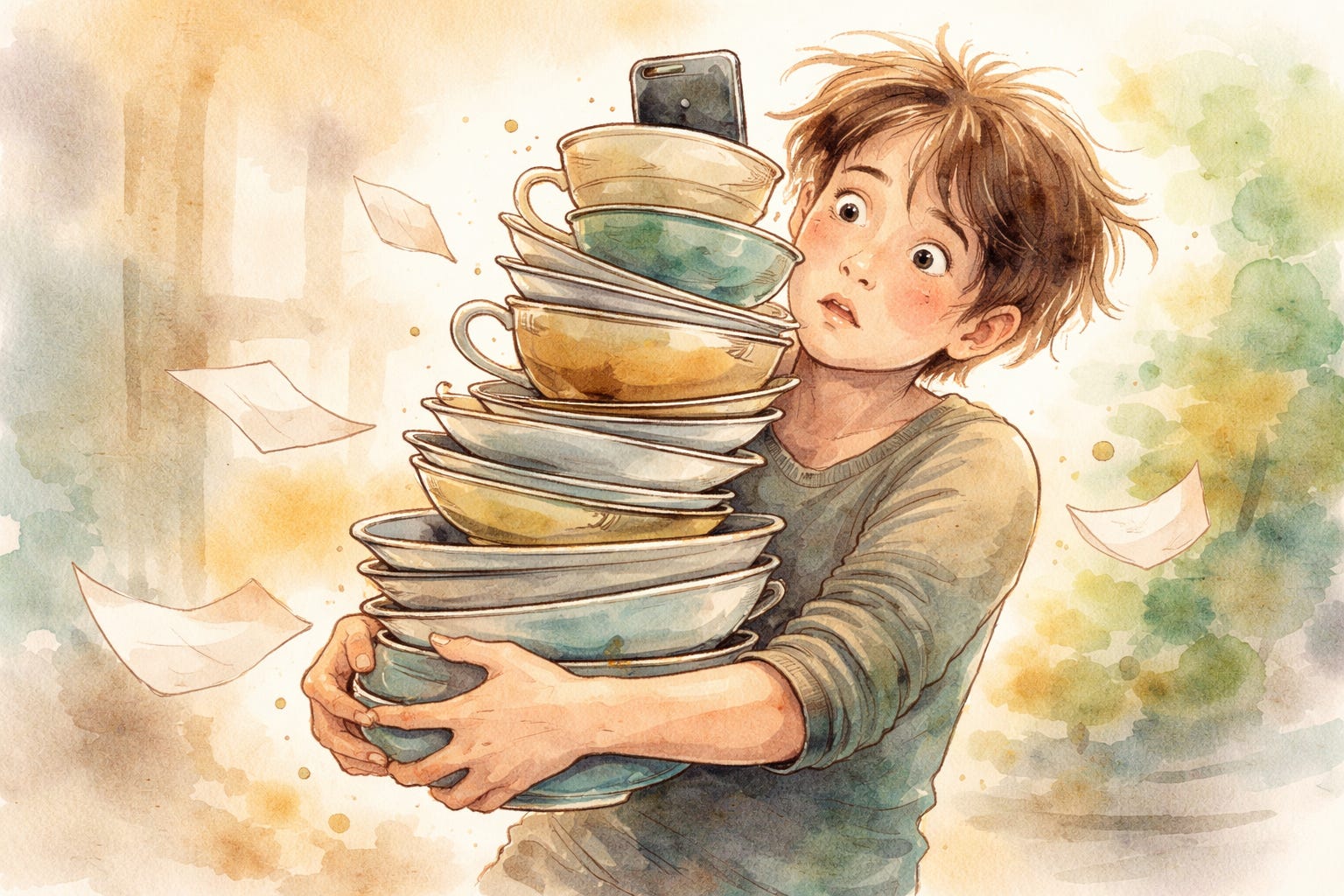
It’s like carrying a stack of fragile glass plates across a room. I’m finally balanced. Finally steady. And someone bumps my shoulder to ask a question. You didn’t mean to knock anything over. But now I’m scrambling to catch shards while reassuring you I’m still listening.
That’s why interruptions can feel physical.
That’s why I ask for a second.
And that’s why a little warning, structure, or choice makes such a big difference.
Quick overview
What an interruption actually asks an ADHD brain to do
1. Preserve the task
Mark where I am so the thought doesn’t disappear.2. Transition
Shift my nervous system from task-world to people-world.3. Perform socially
Listen, remember, clarify, respond well, and not miss anything.All of this happens before you get an answer.
So no, “real quick” is often not quick.
It’s more like:
“Please do a careful shutdown, save your place, reboot into social mode, manage performance anxiety, then deliver.”
Fortunately, there is a way to interrupt without causing an unintentional Chernobyl.
Don’t forget to check out this week’s episode of Riffin About Life with Brian R. King
How to interrupt without knocking someone over
Here are a few concrete solutions that make interruptions less painful for both of us:
Lead with a headline.
“Quick question about dinner” or “Quick question about the email.”
Categories help my brain switch tracks without derailing.Ask for a time window instead of ambushing.
“Is now okay, or can I grab you in 10?”
Giving me a choice lowers the nervous-system spike.Let me bookmark my place out loud.
If I say, “Let me finish this sentence,” that’s Step 1 in action.
I’m saving my place so I can come back without starting from scratch.Put non-urgent asks in writing.
Text it or email it.
If it’s written down, my brain doesn’t have to hold it like a glass of water during an earthquake.If it’s urgent, say that plainly.
“Sorry to interrupt, but this is time-sensitive.”
Now my body understands why it just got tackled.
What I mean when I say “give me a second”
If I say, “Give me a second,” what I mean is this:
Let me do the mental work of stopping in a way that preserves my place, so I can show up for you and still find my way back.
What helps you most when someone needs your attention, but your brain is in the middle of building something?
Thanks for being you,
Brian
“Everything Brian offers, one click away—coaching, podcast, courses, and more:
View all Brian’s Links”