The Biggest Myth About ADHD


Everything I write is free.
Subscriber resources (worksheets, scripts, downloads, companion tools) are also free.
You need to subscribe so I know where to send them.
The biggest myth about ADHD is this:
“People with ADHD could do better if they tried harder.”
It sounds small. Almost reasonable. Like a coffee mug emblazoned with, “Rise and Grind.”
It’s not.
This belief does more damage than the diagnosis ever will.
Not because people mean harm when they say it. Most don’t. They’re trying to motivate. Encourage. Light a fire.
But ADHD isn’t a fire problem.
It’s an ignition problem.
You can have a full tank, a good battery, and still sit, turning the key like,
“C’mon… we talked about this.”
Why this myth sticks
ADHD is invisible.
You can’t tell by looking at us. No casts. No wheelchair. No flashing dashboard light that says:
“Executive Function Offline. Please Restart Human.”
So when someone with ADHD focuses well sometimes, the outside world draws a quick conclusion:
Look? They can do it when they want to.
From the outside, it looks like inconsistency.
From the inside, it’s like trying to steer a Big Wheel downhill.
You’re moving.
But not where you meant to go.
ADHD isn’t a motivation deficit.
It’s a regulation disability.
It affects the brain systems responsible for:
Attention direction
Task initiation
Working memory
Emotional regulation
Time perception
Impulse control
These functions live in executive networks of the brain, influenced by neurotransmitters like dopamine and norepinephrine.
So when someone says, “Try harder,” they assume effort will fix a regulation bottleneck.
But for you, it’s not a motivation problem.
It’s a processing problem.
Your brain is buffering while everyone else is streaming.
And when you write the thought onto the page, it can be like writing on a whiteboard someone keeps erasing behind you, before you can finish the sentence.
You’re not wrong for trying.
You’re not fixing the right problem.
Click to listen to this week’s episode…
Why I call this the biggest myth
I call this the biggest myth because it sits upstream of almost every other misunderstanding about ADHD.
If you believe ADHD is an effort problem, everything gets interpreted through a moral lens.
Forgetfulness becomes careless.
Inconsistency becomes unreliable.
Emotional flooding becomes dramatic.
Procrastination becomes lazy.
The person stops being seen as someone struggling and starts being judged as someone choosing the struggle.
The person with ADHD is sitting there thinking:
“I promise you, if willpower fixed this, I’d be unstoppable by now.”
But ADHD isn’t defined by a lack of caring or a lack of willpower.
It’s defined by differences in regulation and executive functioning.
In other words, ADHD is less about not wanting to do the thing and more about the brain having trouble turning the key in the ignition at the right moment.
How this myth lands in childhood
Parent ↔ Child Dialogue
This myth often lands first at home.
“Why is your homework still not done?”
“I tried.”
“You’ve been sitting there for an hour.”
“I know.”
“Then why isn’t it finished?”
“I don’t know.”
Parent sighs.
“You need to focus.”
“I’m trying to focus.”
“Then try harder.”
Now the child isn’t learning math.
They’re learning shame.
They’re thinking:
What’s wrong with me?
Why can’t I do what everyone else can?
Why ADHD looks confusing from the outside
Someone might hyperfocus for hours on something interesting, and freeze when faced with a 10-minute admin task.
Same person.
Same values.
Same desire to do well.
Different level of nervous system activation.
Interest? Brain says, “Let’s build Rome in a day.”
Boring paperwork? Brain says, “Let’s lie down and question every life choice.”
How the myth strains relationships
Partner ↔ Partner Dialogue
Over time, misunderstanding gets personal.
“Did you call the insurance company?”
“I meant to.”
“You said that yesterday.”
“I know.”
“So why didn’t you do it?”
“I got overwhelmed.”
“It’s a phone call.”
Silence.
“I’m not trying to make your life harder.”
“I didn’t say you were.”
“It feels like you did.”
And now the issue isn’t executive function.
It’s hurt.
One person feels unsupported.
The other feels misunderstood.
Where the myth does its deepest damage
It delays support and teaches shame.
When ADHD gets framed as “try harder,” people often don’t seek evaluation or support until they’re already burned out, anxious, depressed, or convinced they’re broken.
They don’t learn skills.
They learn self-blame.
They start living under the pressure of:
“I should be able to do this.”
Which is exhausting, because they’ve been trying harder their whole life.
They’re not starting at zero effort.
They’re starting at effort plus shame.
The damage this myth causes
Over time, this myth reshapes identity.
Not behavior.
Identity.
It:
Turns neurological limits into moral failure
Teaches people to distrust their own effort
Creates chronic shame instead of skill-building
Replaces curiosity with self-surveillance
Produces burnout, anxiety, and depression
It also creates the world’s worst productivity strategy:
“Panic now. Recover later.”
Which works… until later becomes permanent.
Worst of all, it installs this belief:
“If I’m struggling, it must mean I’m lazy, broken, or not enough.”
Because now the person isn’t just managing executive dysfunction.
They’re fighting themselves too.
Where the myth goes when no one else is in the room
Internal Critic ↔ Self Dialogue
Eventually, the conversation stops happening out loud.
No parent.
No teacher.
No partner.
Just you… and the voice that stayed behind.
You sit down to start something small.
An email.
A form.
A phone call.
Cursor blinking.
And before you move, the voice speaks.
Critic:
“You’re already behind.”
You:
“I know.”
Critic:
“So why are you sitting there?”
You’re not sitting there by choice.
You’re stuck between intention and ignition.
You open the document anyway.
Try to start.
Nothing.
Critic:
“This isn’t even hard.”
“Why do you make everything harder than it needs to be?”
You:
“I’m trying to get traction.”
Critic:
“Normal people don’t need traction to send an email.”
Minutes pass.
Critic:
“You’ve wasted half the morning.”
“At this rate you’ll never catch up.”
Urgency mixes with shame.
Regulation slows even more.
You try to push harder.
Critic:
“If you’d started earlier, you wouldn’t feel like this.”
You:
“I couldn’t start earlier.”
Critic:
“Excuses.”
Eventually urgency spikes high enough to override paralysis.
You start.
Finish.
And then…
Critic:
“There. That wasn’t so hard.”
Which erases the invisible cost it took to get there.
Where the dialogue begins to change
When ADHD is understood as regulation, not effort, the voice shifts.
Slowly.
But noticeably.
Critic:
“You’re behind.”
You:
“I lost traction, not commitment.”
Critic:
“This isn’t hard.”
You:
“Starting is the hard part for my brain.”
Critic:
“You always wait.”
You:
“Urgency jumpstarts my nervous system.”
Same situation.
Different interpretation.
Less shame.
More strategy.
Because the goal isn’t to silence the critic.
It’s to stop letting it narrate reality unchecked.
To replace:
“What’s wrong with me?”
with:
“What support would help me start?”
One question attacks identity.
The other builds competence.”
Thanks for being you,
Brian
Everything Brian offers, one click away—coaching, podcast, courses, and more:

Free Workbook
There’s a workbook that goes with this article.
It’s almost done. I want it to be genuinely useful, not busywork, so I’m polishing it.
Subscribers will get it as soon as it’s live.
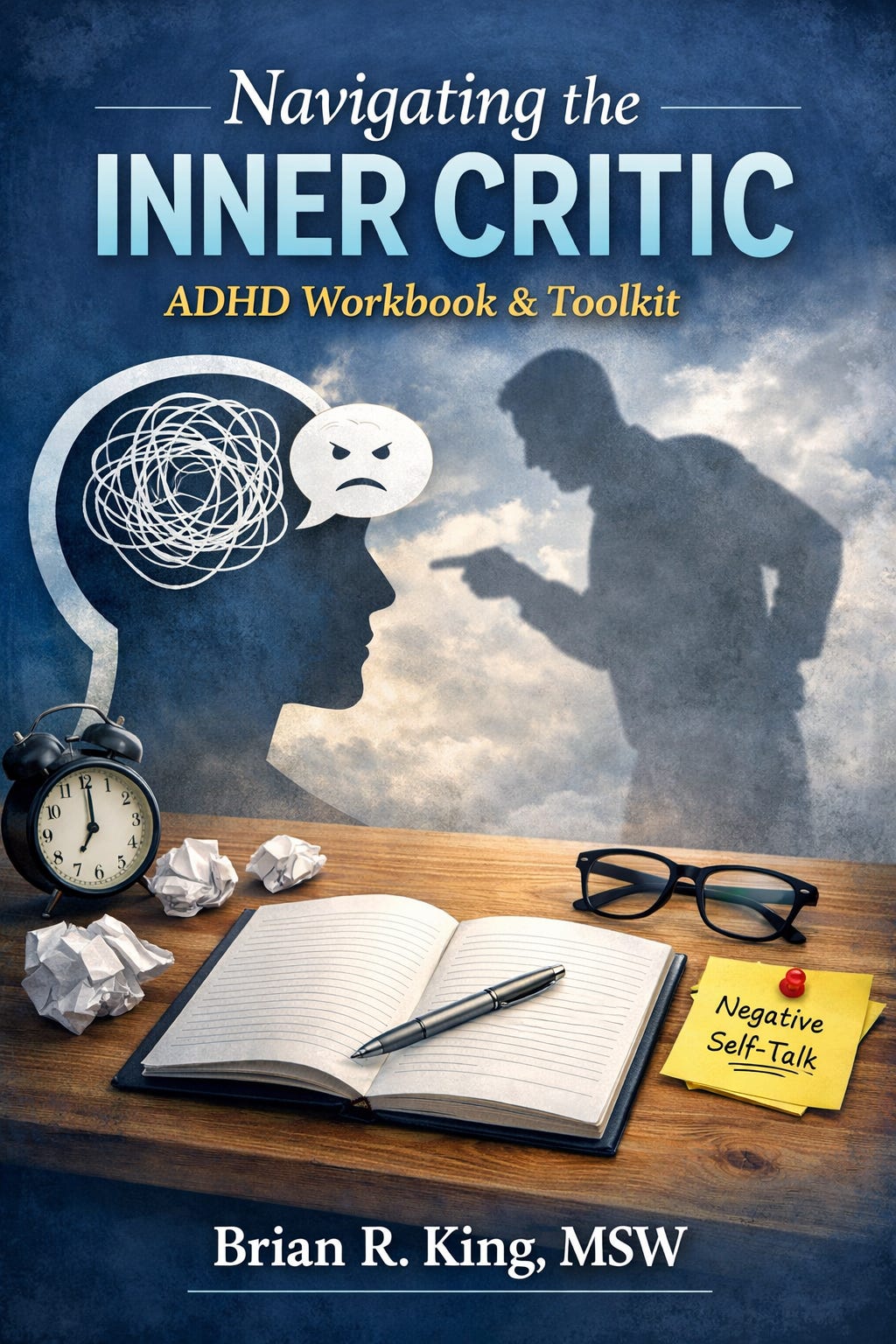
If you’re not subscribed yet, jump in, and I’ll send it your way when it’s ready.